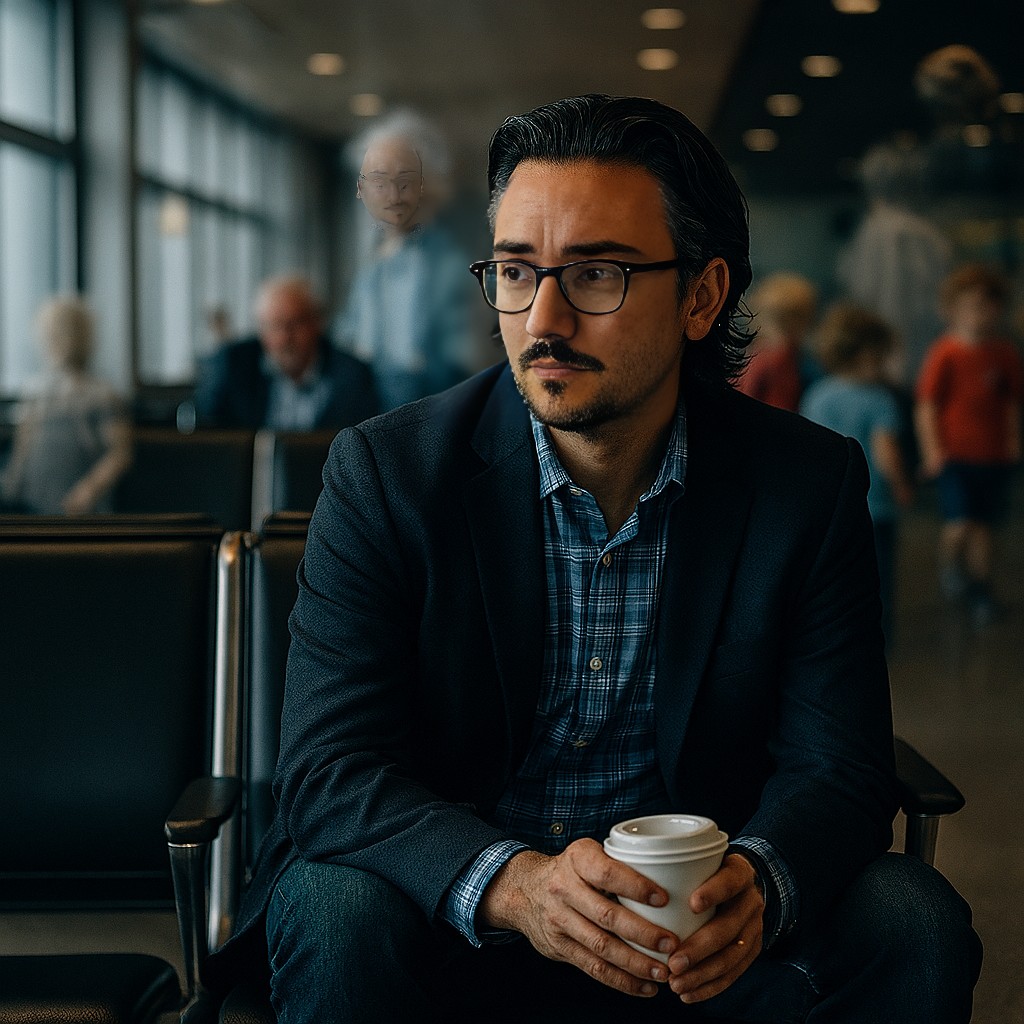
There’s a particular kind of dread that comes with airports. It’s not just the bad coffee, the overpriced sandwiches, or the way people suddenly forget how to walk in a straight line when they see a “Gate 14 →” sign. No, for me it’s something deeper, a low-grade hum in my nervous system that started years ago, somewhere between my first dead body and my last.
You can blame it on the uniform. Not the flight attendant kind, the other one — navy blue with reflective striping. The one I wore when I was a paramedic. The one that taught me that bad things happen fast, and often without warning. You’d be driving along, eating a stale granola bar, and then — bang — someone’s heart decides to quit. Someone’s car decides to roll. Someone’s life decides to end in your hands.
Airports feel like that. Not because anyone’s dying (hopefully), but because they’re a pressure cooker of unpredictability. Delays, missed connections, screaming babies, the guy next to you who thinks deodorant is optional — it’s all a cocktail of uncertainty, and uncertainty is PTSD’s favorite drinking buddy.
They tell you to “arrive two hours early” like it’s a tip. For me, that’s just two extra hours for my mind to wander down dark alleys. What if I miss the flight? What if I panic on the plane? What if some medical emergency kicks off mid-air and the flight attendant does that thing where she says, “Is there a doctor on board?” and all eyes turn to me, and I have to explain that I used to be the guy, but now I’m not sure I could even open the kit without shaking?
And then there’s Greece. The promise of blue water, ancient ruins, and baklava sticky enough to glue your soul back together. I should be excited. I am excited. But excitement and anxiety are Siamese twins joined at the chest. My brain can’t tell them apart. It feels the same in my body: racing heart, tight chest, that hollowed-out stomach that makes the airport sandwich look like a dare.
I hate airports because they’re the waiting room for the rest of the world, and I’ve spent enough time in waiting rooms. ER hallways with buzzing fluorescents. Ambulances idling outside houses where someone’s screaming inside. Even my own mind feels like a waiting room sometimes — just me and a row of uncomfortable chairs, waiting for the next thing to go wrong.
But here’s the truth I keep trying to swallow like a bad pill: I’m still going. I’m still boarding that plane. I’ll sit there, knees tapping, pretending to read the in-flight magazine while the kid in front of me kicks my seat, and I’ll make it to Greece. Because the thing about PTSD is, yeah, it screws with your wiring — but it doesn’t have to decide where you land.
I do.
PTSD is not a limitation — it’s the long way round. You can still get to where you want to go, it might just come at different times. Maybe it’s breathing into a paper bag, having a moment in a corner, or wishing for a drink that you can’t and won’t consume… PTSD is a bitch. No doubt.
But Greece? That’s where I’m gonna hang my towel for a while. PTSD can just fucking deal with it!







 Author Matthew Heneghan
Leave a comment